The Sins of the Past
That Just Won't Die.
Pennsylvania used the trauma of one institution to write rules that punished the survivors of another. Adults with autism, Down syndrome, and cerebral palsy are still paying the price for a fear that was never about them.
Act I: Pennhurst —
The Original Sin
Pennhurst State School and Hospital opened in 1908 in Chester County, Pennsylvania. It was built to warehouse people with intellectual and developmental disabilities — the exact population Front Porch Cohousing exists to serve today: adults with autism, Down syndrome, cerebral palsy, traumatic brain injury, and related conditions.
For nearly 80 years, the state of Pennsylvania built it, funded it, staffed it, and defended it. The federal court record from the landmark Halderman v. Pennhurst trial in 1977 is unambiguous: residents were subjected to physical abuse by staff, left in their own waste, denied individualized programming, and — critically — were losing skills over time. The institution was not merely failing to help people. It was actively making them worse.
Federal Judge Raymond Broderick's 1978 ruling described Pennhurst as a place where residents were "deprived of their constitutionally and statutorily protected rights." He ordered it closed. The state fought the order for nearly a decade before the last residents were finally moved in 1987.
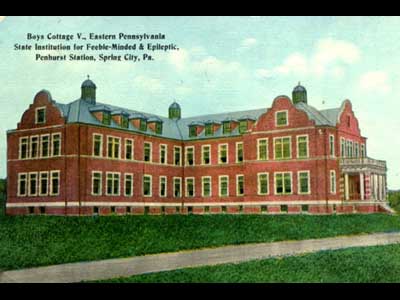
Pennhurst Station, Spring City, Pa. · Historic postcard, c. early 1900s
"The evidence showed that Pennhurst residents were subjected to indignities that no human being should have to endure."
Who Was Actually at Pennhurst —
And How They Got There
Pennhurst was not filled exclusively with people who had severe intellectual disabilities. The admission criteria were extraordinarily broad — and were routinely abused. Children labeled as "behavioral problems" at home or in school were committed, often by parents who had no other support options, or by school districts that simply did not want to educate them. Children with epilepsy were institutionalized, as seizures were routinely misclassified as mental deficiency. Children from poor and immigrant families were disproportionately committed — the institution served as a social dumping ground as much as a medical one.
Lifetime institutionalization. No educational programming required by law.
Institutionalization standard. Minimal vocational training permitted.
Eligible for commitment. Often used to justify removing "behavioral" children from schools.
Theoretically exempt — but IQ tests were routinely administered in ways that produced artificially low scores.
IQ testing was weaponized. The Stanford-Binet and similar tests of the era were administered in English to non-English-speaking children, to children who had never held a pencil, and to children who had been isolated from any educational stimulation. The resulting scores were used to justify lifetime institutionalization. A child who scored below 70 could be legally committed. A child who scored below 50 was classified as an "imbecile." Below 25 was an "idiot" — not a slur, but a legal, clinical term embedded in Pennsylvania statute.
The Halderman v. Pennhurst trial testimony revealed something even more damning: some residents, when finally evaluated properly after decades of institutionalization, had IQs and functional abilities far above what their admission records indicated. The institution had not merely failed to develop them. It had actively suppressed their development to the point where their original classification could no longer be verified or disproven.
"The same system that labeled a child 'behaviorally disordered' for stimming in a classroom, gave them a flawed IQ test, and committed them to Pennhurst for life — that same system is now writing the rules that govern where their grandchildren can live."
The parents of adults with autism, Down syndrome, and cerebral palsy today are one generation removed from a system that would have institutionalized their children based on a flawed test administered by someone who had already decided the outcome. We should not be surprised that the successor to that system is still getting it wrong.
Act II: The Promise —
The Research That Proved It Could Work
When Pennhurst residents were finally moved into Community Living Arrangements (CLAs) — small homes in regular residential neighborhoods — something remarkable happened. The federal government commissioned a five-year longitudinal study through Temple University to track outcomes. The results were unambiguous.
The research also found that smaller settings produced better outcomes. After controlling for residents' initial functioning levels, people in smaller community homes made larger adaptive behavior gains than those in larger ones. The lesson was clear: the more a setting resembles a real home, the better people do.
The promise was real. The research confirmed it. People who had been written off by the state — institutionalized for an average of 24 years — were growing, learning, and thriving in community homes. The generation born in the late 1980s and 1990s was promised this would be their world.
Byberry — The Political
Trauma That Rewrote the Rules
Byberry — the Philadelphia State Hospital — was a psychiatric facility. It served a completely different population than Pennhurst: adults with mental illness, not intellectual and developmental disabilities. But its collapse was so catastrophic, so visible, and so politically toxic that it became the defining image of institutional failure in Pennsylvania.
In 1946, Life magazine published photographs of naked, emaciated patients at Byberry — images that a journalist compared to photographs from Nazi concentration camps. The state was put on notice. It took 44 more years to close it. At its peak, Byberry held 7,000 patients. When it finally closed in 1990, the images were seared into the minds of every Pennsylvania legislator.
Act III: The Betrayal —
The Villain Changed Its Costume
Terrified of ever being responsible for another Byberry, Pennsylvania policymakers overcorrected. They applied the trauma of a psychiatric hospital to the IDD community. They wrote the ODP "4-person rule" and implemented the federal HCBS Settings Rule in a way that treats voluntary homeownership as equivalent to institutionalization.
The critical distinction they erased: You cannot "warehouse" someone who owns their own home. Pennhurst was forced custody. Byberry was forced custody. A person who holds a deed, pays a mortgage, and chooses their neighbors is exercising the most fundamental form of community integration the law can recognize. The state's rules treat these as the same thing.
Pennsylvania did not set out to break its promise. But it has been complicit in three distinct phases of harm: first by building and defending institutions it knew were abusive; then by closing them without building adequate community alternatives; and now by writing regulations that prevent the private sector from filling the gap the state created. The villain did not retire. It changed its costume.
Pennsylvania used the trauma of a psychiatric hospital to write rules that punished the survivors of an IDD institution. Adults with autism and Down syndrome are still paying the price for a fear that was never about them.